Energy Comparison: What the Price Cap Does, and What It Does Not
The most common misunderstanding about British energy bills is that the cap caps the bill. It does not. It limits what a supplier may charge per unit and as a standing charge on a standard variable tariff, and your bill is those rates multiplied by what you use.
The two figures that decide the total
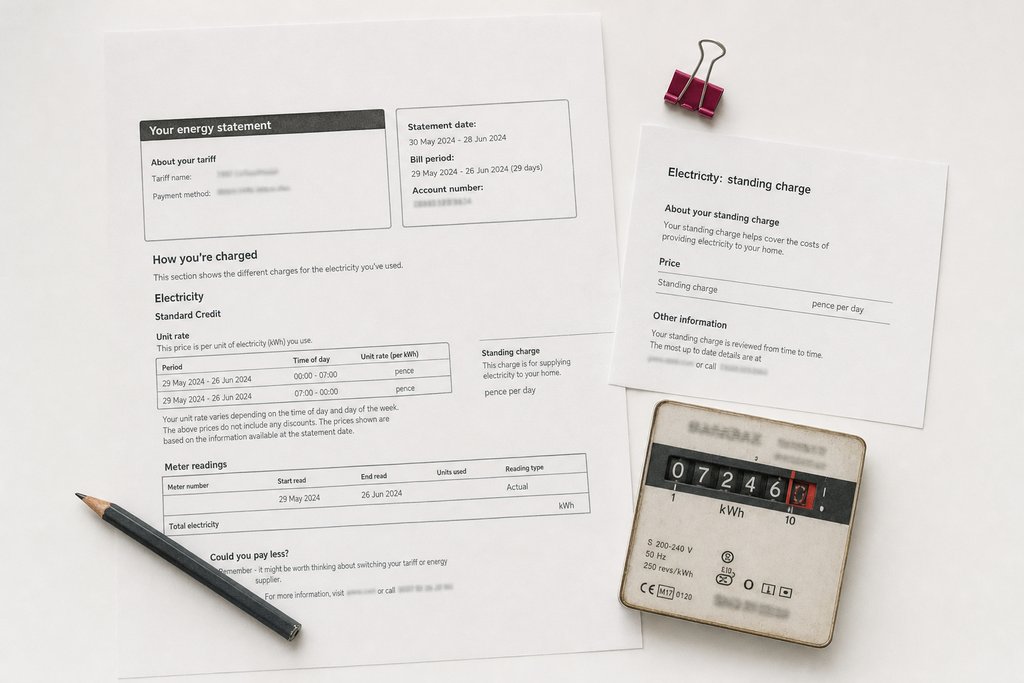
A unit rate, charged per kilowatt hour of gas or electricity, and a standing charge, levied daily regardless of usage. Every tariff is a combination of the two, and comparing tariffs means comparing both rather than one.
That matters because the balance between them changes who wins. A low unit rate with a high standing charge suits a heavy user; the reverse suits a small flat that is empty much of the week. Two households can rationally choose differently from the same list.
Which is why annual-cost estimates on comparison sites are only as good as the usage figure fed into them. Enter your actual annual kilowatt hours from a bill rather than accepting a default household profile, or the ranking is describing somebody else.
Why the cap changes, and what that means for fixing
The cap is reset periodically to reflect wholesale costs and other allowances. It moves both ways, and it is announced ahead of taking effect, which is the window in which fixed-tariff decisions get made.
A fixed tariff is therefore a bet on where the cap goes next. Fix below the current cap and you win if the cap rises or holds. Fix above it and you are paying for certainty rather than for a saving.
There is nothing wrong with paying for certainty: a fixed bill is genuinely valuable to a household on a tight budget, but it should be a conscious purchase rather than an assumption that fixing is always cheaper.
Exit fees, and the clause worth reading
Most fixed tariffs carry an exit fee if you leave before the end date, usually per fuel. That is the cost of changing your mind, and it is what makes a long fix a genuine commitment rather than a preference.
The exception worth knowing: you can normally leave a fixed tariff without a fee in the final weeks before it ends, which is the window to shop in rather than waiting for it to expire.
When a fix ends and nothing is done, the account rolls onto the supplier's standard variable tariff. That is not a penalty, but it is rarely the best available rate.
What switching supplier actually changes
The billing relationship and the tariff. Not the gas, not the electricity, not the pipes or wires, and not who fixes a fault, that is the network operator for your region and it does not change whoever you buy from.
So a switch cannot improve reliability and cannot cause an interruption. Anyone worried about the supply going off during a switch can be reassured: the physical supply is untouched.
What can go wrong is administrative, a misread meter, an overlapping bill, a credit balance left behind. Take a photograph of the meter on switching day, which resolves nearly all of it.
Meters, and the direct debit question
A smart meter removes estimated readings, which is its real benefit: an estimated bill is where unexpected balances come from. It also enables time-of-use tariffs, which reward shifting usage to cheaper periods and only suit a household that genuinely can.
Direct debit is usually cheaper than paying on receipt of bill, and it works by estimating your annual cost and dividing by twelve. That means a credit balance builds over summer by design, and it also means a wrong estimate is a wrong monthly figure.
Check the estimate against your actual annual usage once a year. A large credit balance is your money and can be requested back; a large debit is a payment rise waiting to happen.
Reducing the usage half of the equation
Comparison changes the rate; it does not change the kilowatt hours. And in most homes the usage side is where the larger number sits, concentrated in a small number of places rather than spread thinly across appliances.
Heating is nearly all of it. A degree off the thermostat, heating rooms that are used rather than the whole house, and getting the timing right for how the household actually lives will move a bill further than any tariff switch. Hot water is second, and a cylinder thermostat set higher than it needs to be is a quiet, continuous cost.
The appliances people worry about are mostly noise. Standby consumption on modern electronics is genuinely small, and switching things off at the plug is a rounding error next to an hour of extra heating. Tumble dryers and electric showers are the real exceptions, because both convert a lot of electricity into heat quickly.
Where a supplier offers a time-of-use tariff, the usage question and the tariff question merge: shifting laundry and dishwashing to a cheap window pays only if the household can genuinely do it, and costs money if it cannot.
What to do, in order
Get your annual usage in kilowatt hours from a recent bill or the supplier's app. Compare on that figure rather than a default profile. Check both the unit rate and the standing charge, and check the exit fee before fixing.
Then diarise the fix end date, and photograph the meter whenever you switch. See the other fixed costs worth reviewing and where the same renewal mechanism applies.
Frequently asked questions
Does the price cap limit my bill?
No. It limits the unit rate and standing charge a supplier may charge on a standard variable tariff. Your bill is those rates multiplied by your usage, so a capped rate and a large bill are entirely compatible.
Should I fix my energy tariff?
It is a bet on where the cap goes next. Fixing below the current cap wins if the cap rises or holds; fixing above it is paying for certainty. Both can be reasonable, but it should be a conscious choice.
Why do comparison sites give me different annual figures?
Because they are using different usage assumptions. Enter your actual annual kilowatt hours from a bill rather than accepting a default household profile, or the ranking is about somebody else.
Will my supply be interrupted if I switch?
No. A switch changes the billing relationship and the tariff only. The gas, the electricity, the network and the people who fix faults are unchanged and are determined by your region.
What is an exit fee?
A charge for leaving a fixed tariff early, usually per fuel. You can normally leave without one in the final weeks before the fix ends, which is the window to shop in.
Is my direct debit amount right?
Check it against your actual annual usage once a year. It is an estimate divided by twelve, so a building credit balance is your money and can be reclaimed, and a growing debit is a payment rise coming.